Regulatory weight
HIPAA and its equivalents worldwide put a hard duty on minimizing how much personal health information moves and who sees it. Every unnecessary disclosure is exposure.
Issuance with Credence lets healthcare organizations issue verifiable credentials for clinicians, patients, and coverage - where a pharmacy can confirm insurance without seeing a diagnosis, and a clinic can confirm a patient is consent-capable without seeing their address. Privacy isn't a policy bolted on afterward. It's built into the cryptography.
ISO/IEC 18013-5 · W3C VC 2.0 · OpenID4VCI · FIPS 140-3 Level 3 · ISO 27001 · Selective disclosure
Healthcare runs on people proving things about themselves to each other - a doctor proving they're licensed, a patient proving who they are, a member proving they're covered. And almost none of those interactions need a full identity disclosure to work.
Three forces are pushing the sector to fix it.
HIPAA and its equivalents worldwide put a hard duty on minimizing how much personal health information moves and who sees it. Every unnecessary disclosure is exposure.
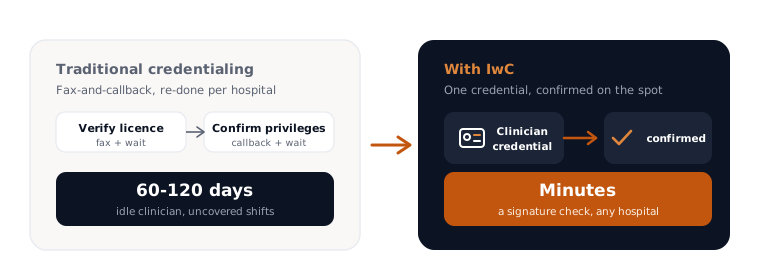
Credentialing a clinician the traditional way - degrees, board certifications, licensure, hospital privileges - takes 60 to 120 days of faxes and callbacks. That is a locum doctor sitting idle, or a shift going uncovered.
Forged credentials, stolen patient identities, and prescription fraud all trace back to the same root: verification that's slow, manual, and easy to fake.
The status quo forces a bad trade at every interaction: reveal too much, or verify nothing.
To confirm one fact - coverage, age, licensure - the old way hands over the whole record. There's no clean mechanism to share just the attribute a check actually needs.
A clinician's qualifications are re-verified from scratch at every hospital, through a fax-and-callback process that stretches to three or four months. Portable, instant verification simply does not exist on paper.
Insurance details transcribed by hand introduce errors that surface later as denied claims and billing disputes - and paper check-in is where medical identity theft slips in.
IwC changes what each healthcare interaction reveals - and how fast it resolves.
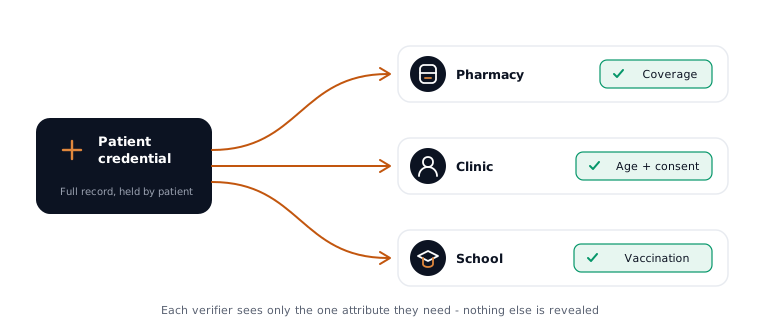
Selective disclosure means a verifier sees exactly one fact and nothing else. Over 18 and consent-capable, without the address. Insured, without the claims history. Licensed, without the home details.
A physician presents a single verifiable credential - licence, certifications, privileges - that any hospital confirms instantly, replacing the fax-and-callback with a signature check.
Every credential is signed in a validated hardware security module and bound to the holder's device. A forged clinician credential, a stolen patient identity, or a tampered prescription fails the moment it's checked.
Run issuance and verification for clinicians, patients, and coverage from one platform, with privacy controls baked into every credential.
Configure credential templates, issue, and verify through the IwC Portal, the API, or the Verify with Credence tooling - no cryptographic infrastructure to stand up first.
Verify a clinician at a hospital entrance, admit a patient at a clinic desk, or confirm coverage at a pharmacy counter - the same credential works in person and online.
Role-based approvals, configurable issuance and revocation, and an append-only audit log of every lifecycle event - exportable into your compliance and SIEM systems, ready for a HIPAA review.
The value shows up every time a credential is presented - because in healthcare, the same credential gets checked constantly, by parties who should each see a different slice of it.
Issue a clinician credential once; every hospital, staffing agency, and pharmacy that accepts it trusts your verification instead of rebuilding it.
When a verifier only ever sees the one attribute they need, the surface area for a privacy breach shrinks to almost nothing.
A licence suspended, a privilege revoked, a device lost - report it and the credential is invalidated immediately, before it can be misused.
For prescriptions and controlled substances, the issuing physician's identity, the patient's identity, and the prescription itself are bound together and verifiable as one chain.
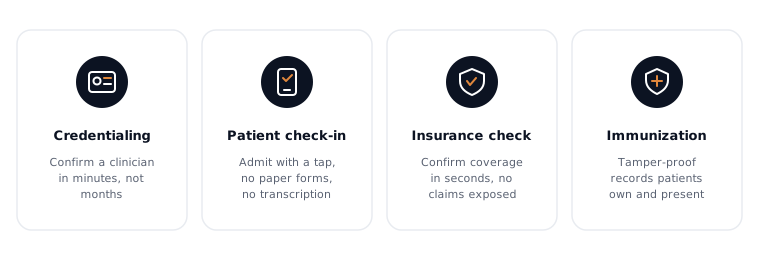
Healthcare organizations issue several credential types on IwC - each proofed and signed the same way, each designed for selective disclosure.
Medical licences, specialty certifications, and hospital privileges in a single verifiable credential a locum or travelling clinician carries between institutions.
A wallet-based identity credential that admits a patient with no paper forms and no transcription errors on their details.
Proof of coverage a pharmacy or provider confirms in seconds - without ever seeing the member's claims history or diagnosis.
Issued by the provider or public health authority, verifiable by schools, employers, and border control - on standards that have matured well past the pandemic-era versions.
For controlled substances, cryptographically linking the prescribing physician, the patient, and the prescription itself.
Issue once, verify anywhere, reveal only what each check needs.
Because IwC issues over OpenID4VCI in both ISO 18013-5 and W3C VC 2.0 formats, the credential works with any conformant wallet and verifier - and selective disclosure is native to the cryptography, not a feature layered on top.
IwC gives healthcare organizations the tools to move faster while disclosing less. Patients keep control of their health data; clinicians carry their qualifications wherever they work.
A clinic confirms a patient is over 18 and consent-capable without their address; a pharmacy confirms coverage without the diagnosis. Selective disclosure makes minimal disclosure the default.
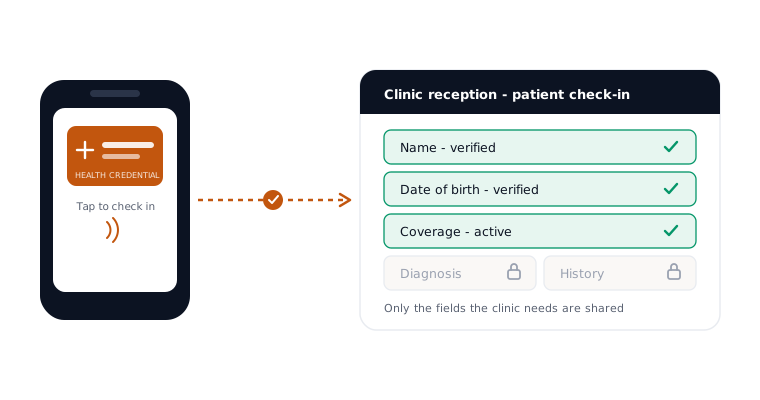
A patient admits with a tap - verified name, date of birth, and coverage status - with no forms to fill and no details to transcribe.
A locum doctor presents one credential at every hospital, instead of waiting days for each to re-verify from scratch.
Insurance member credentials confirm eligibility at the counter in seconds, cutting denied claims that trace back to transcription errors.
Device-bound, hardware-signed credentials make stolen or forged patient identities fail at the point of care.
Built on ISO and W3C foundations, vaccination and identity credentials are recognized by schools, employers, and border control well beyond a single provider.
IwC is built by Credence ID, an ISO 27001-certified organization with digital identity and biometric technology deployed in the field across more than fifteen countries, on cloud infrastructure that meets regulated-industry requirements.
Working with Credence ID, your organization gets a standards-based credential platform - proofing, issuance, and privacy-preserving verification - backed by proven technology, regulated-grade hosting, and expert support. Get in touch to learn more or to start a pilot.
Issuance with Credence - Issue once. Verify anywhere. Reveal only what's needed.