Regulatory weight
KYC and AML law require customer due diligence at onboarding, sanctions and PEP screening, and ongoing monitoring - increasingly framed as perpetual KYC rather than a one-time check. The obligations only grow.
Issuance with Credence lets banks and fintechs run identity proofing to a regulated standard, then issue the result as a reusable digital credential the customer carries - cutting onboarding from days to minutes, without loosening a single compliance control.
ISO/IEC 18013-5 · W3C VC 2.0 · OpenID4VCI · FIPS 140-3 Level 3 · ISO 27001
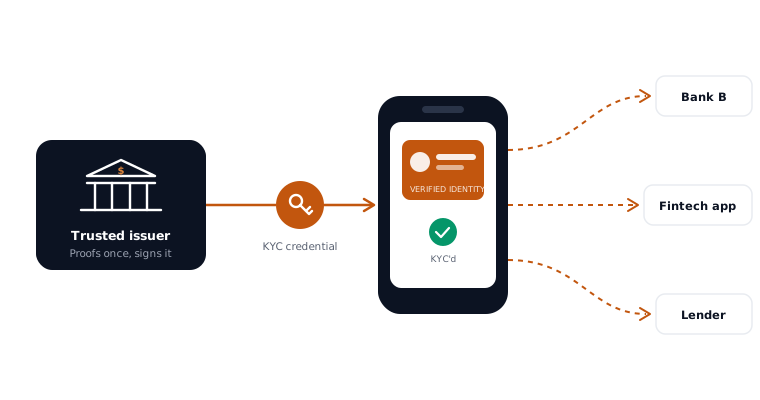
Every regulated institution proofs the same customers, over and over. A person who has been KYC-checked by one bank uploads the same passport scan, the same proof of address, the same selfie to the next bank, the next fintech, the next lender - and each one pays to verify it again from scratch.
Three pressures are forcing the issue.
KYC and AML law require customer due diligence at onboarding, sanctions and PEP screening, and ongoing monitoring - increasingly framed as perpetual KYC rather than a one-time check. The obligations only grow.
People open accounts from their phones and expect approval in minutes. A multi-day proofing process with document uploads and callbacks feels broken next to every other app they use.
Synthetic identities, document forgery, and account-takeover attacks are getting more sophisticated. Detecting them at onboarding - before an account exists - is far cheaper than chasing them afterward.
The status quo taxes both sides of every account opening.
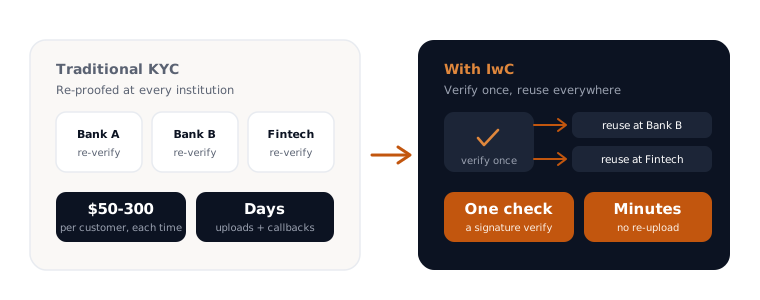
Each institution rebuilds the same verification the last one already did. No portability, no reuse, no shared trust - just duplicated cost across the sector.
Every extra document upload and verification step is another point where a customer gives up. Days-long approvals lose applicants who would have converted in minutes.
When identity checks are shallow or bolted on after the fact, forged documents and synthetic identities slip through - and the cleanup costs far more than the prevention would have.
IwC changes the economics of proofing a customer. Do it once, to a regulated standard, and the verified identity becomes a credential the customer reuses everywhere.
A customer already proofed by a trusted issuer presents a verified credential; a new institution confirms it and opens the account in under a minute - instead of days.
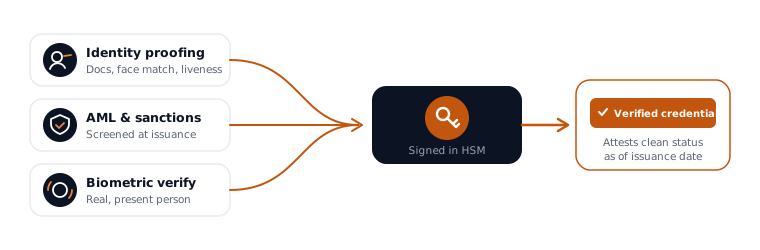
Identity proofing, AML and sanctions screening, and biometric verification all run before the credential is minted. The credential itself attests to a clean, verified status as of its issuance date.
Credentials are cryptographically signed in a validated hardware security module. A forged or altered credential fails the moment a verifier checks the signature - there's nothing to detect after the fact.
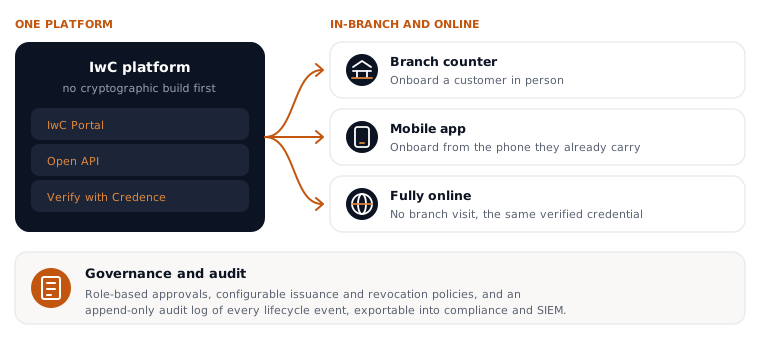
Run proofing, issuance, and verification from one platform, backed by open APIs and controls your compliance team will recognize.
The value doesn't end when the account opens. A bank that issues a verified identity credential becomes a trusted issuer for the rest of the customer's financial life - and that position compounds.
When your bank proofs a customer and signs the credential, every downstream institution that accepts it is trusting your verification. You anchor the customer's identity across the sector.
Verified once, reused everywhere. The $50-300 you would spend re-proofing a customer collapses to a signature check against a credential you can trust.
Hardware-signed credentials and proofing at issuance shrink the attack surface for synthetic identity and account-takeover fraud.
Issue a basic identity credential off a single in-branch verification, then let the customer use it to open accounts elsewhere - bringing people into the financial system who couldn't clear traditional onboarding.
Financial institutions issue more than one kind of credential on IwC - each proofed and signed the same way.
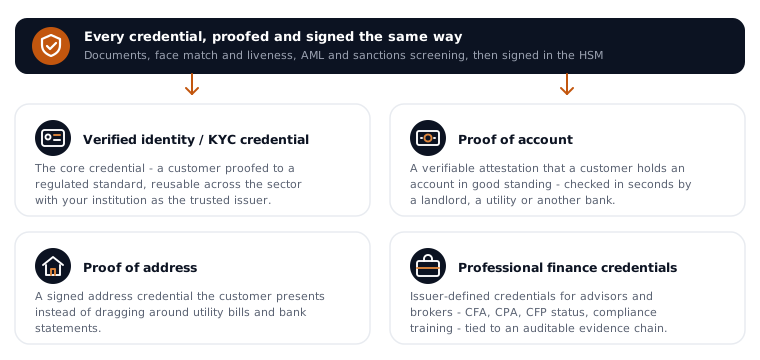
A customer proofs once and carries the result. Here is the shape of it.
Because IwC issues over OpenID4VCI in both ISO 18013-5 and W3C VC 2.0 formats, the credential works with any conformant wallet and any conformant verifier - not just tools carrying our name.
IwC gives financial institutions the tools to serve customers faster while holding the line on compliance. The pitch to the customer is refreshingly simple: stop uploading the same passport scan to every new app you sign up for.
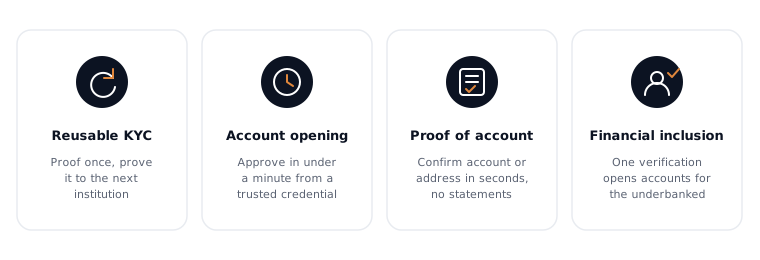
A reusable credential turns account opening into a single verification step - fewer abandoned applications, more completed ones.
Selective disclosure means a customer shares only the attribute a check needs - proof of account, or that they are over 18 - never the whole identity file.
Proof-of-account and proof-of-address credentials get confirmed in seconds, across institutions, without paperwork.
One in-branch verification opens the door to accounts everywhere, for customers the old process left out.
Hardware-signed credentials and proofing at issuance keep synthetic identities and forged documents out of the system.
Built on ISO and W3C foundations, the same credential is recognized beyond a single institution or jurisdiction - useful wherever a customer's money and identity travel.
Working with Credence ID, your institution gets a standards-based credential platform - proofing, issuance, and lifecycle management - backed by proven technology, regulated-grade hosting, and expert support. Get in touch to learn more or to start a pilot.
Issuance with Credence - Verify once. Trust everywhere. Manage for life.